
Tu tu tu b’Shvat!”, we sing in a song for the birthday of the trees. What is Tu b’Shvat? Tu b’Shvat is essentially the Jewish Arbor Day. Its historic roots extend back to ancient Israel when there was a tithe on trees. Like tax season, the 15th of the month of Shevat was the cut off for the tithe to be fulfilled from the previous year. “Tu” represents the numbers from the two Hebrew letters, each one having a numerical value (Tet = 9 and Vav=6). The 15th of the Hebrew month of Shevat is when springtime arrives in that region and the tree sap begins to riseIn 16th century Safed, Israel, the mystics revived this ancient tradition by incorporating spiritual concepts into a Seder, much like our Passover Seder, to celebrate the trees. 
The Tu b’Shvat Seder includes four cups of wine/juice, each one redder than the one before, representing the rising sap in the trees and the changing seasonsThe first cup is completely white for winter. A little more red is added for each successive season. The last cup of wine, representing the fall, the fullness of our harvest, is all red. A question: how do you represent the changes in your spiritual world from winter to summer? Do you give yourself extra self-care time? Aspring begins, how does your expression of life change? Maybe you plant a garden. Or, exercise outdoors more. Then there are always wardrobe changes!
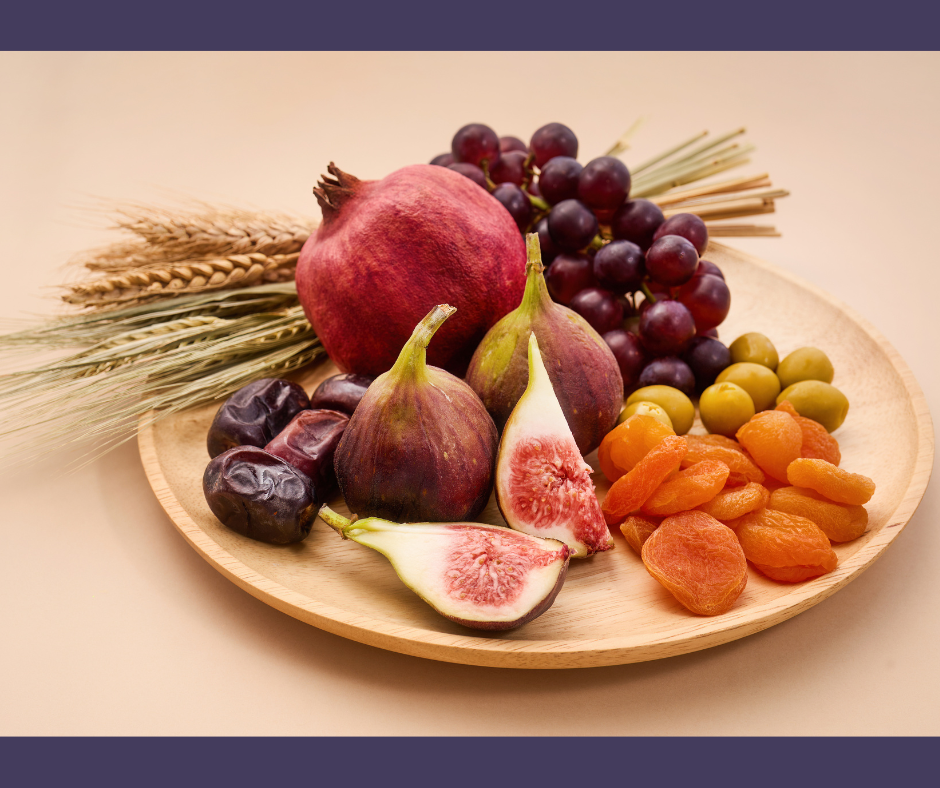
Different fruits, nuts, and seeds, all part of a Tu b'Shvat seder, arranged in a circle on a wooden platter.

Fruits and nuts are part of the Tu b'Shvat seder, too!

The Kabbalists, mystics, of Safed, also incorporated nuts and fruits into the Tu b’Shvat Seder. They suggested that humans have qualities to consider that are reflected in these small objects of holiness. For instance, take a walnut. Hard exterior shell, but yummy interior nut to eat. I remember when I made cookies with my grandmother and had to crack open the walnuts. That took time and was not so easy. How do you develop a hard exterior? It is essential sometimes for life and survival. The walnut represents winter. When do you have to be strong to protect your inner heart during the colder monthsMaybe it’s a house with a deadbolt. There are so many layers when considering the walnut’s hard shell and what keeps you protected in winter, what makes you safe. 

However, to let people in and be in relationships, we need to crack our outer shell to welcome the world into our lives and hearts. Sometimes, we have to monitor knowing when to remove the hard shell. Then there is a fruit like a banana! Soft inside and out. You still need to remove the soft exterior to enjoy the yummy fruit inside. I think you can see where I am going here. 

Imagine summer, fruits that are completely edible. Raisins. No pits. No seeds inside. No protective layer. Summertime. When is your life in at a point where you don’t need protection. I’m imagining it’s when you or we are in a place we feel safe and don’t need the shells of winter. The time of openness is a creative time in our lives. Full out with who we are. We are in a place and space that we trust those around us and can truly be ourselves. 


Place the fruit or nut in your hand. Examine it. Think of it as a microcosm of your spiritual self, even considering its size in this enormous world and the power it has in its simple beauty, just like you!
Rabbi Yonina

Now, back to the trees...

Finally, there is so much more to say about trees….. they’ve been here long before any of us, bearing fruit, giving us shade, providing wood for all kinds of things, and they will be here long after we’re gone. The story of Honi the Circle Maker a good place to close our reflection this month. .If you want to hear the story sung, reach out to me to hear it! Honi the Circle Maker was a revered person from ancient Israelknown in the Talmud* for his ability to pray for rain. The story goes that he saw a person planting a carob tree. The carob tree we are told takes 70 years to bear fruit. Since it was unlikely the person planting the tree would be alive to see it bear fruit, Honi asked, “Why are you planting this tree? Their response? “I am planting the tree for future generations because trees were planted for me.” As our tradition notes, “L’dor vador,” from generation to generation.  

We are intrinsically connected to all that is around us. This world was here long before we were born. The world will be here long after we have died. Indeed, keep planting your trees even if someone very important comes along. Rabbi Taron says in Pirket Avot, Ethics of our FathersIt is not your duty to finish the work, but neither are you at liberty to neglect it.”  May you find your tree, your nut, your seed, and nourish your life reflecting the parallels between you and the natural world.  

*Talmud is the central text of rabbinic Judaism, compiled between the 3rd and 6th centuries CE 

– Rabbi Yonina  

Click below to learn more about JFS’ Jewish Community Services.