
Maybe it all began with the “Why?” of our Passover Seder questions. They are known as the Four Questions, “Mah Nishtana?” There’s an inquiry followed by four specific examples that the children call out, “Why? Why? Why? Why?” The question has driven me throughout my life. It’s what prompted a Jewish Nobel Prize winner to become a scientist. His mother asked what questions he asked each day at school, not what he had learned.
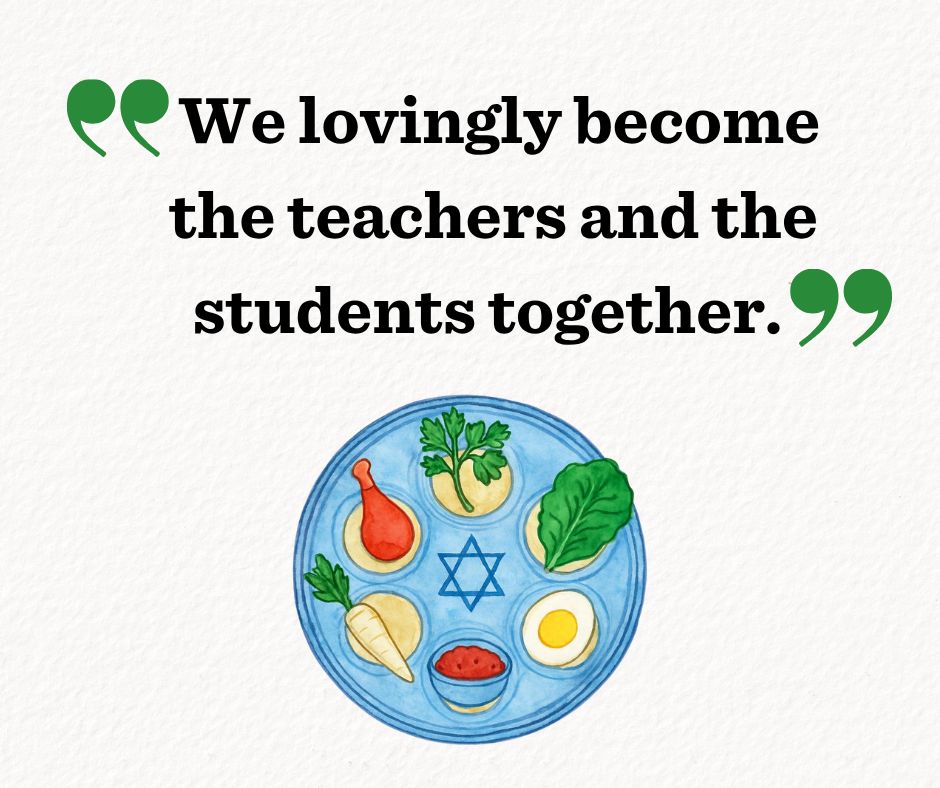
Our Four Questions are sung by the children at the yearly Passover Seder each spring. We sit, or recline, around a table or tables set for a festive meal eaten mid-way through the telling of our Passover story, the story of our people’s escape from Egypt. We tell the story aloud reading from the booklet called the Haggadah, a name translating literally to, ‘The Telling’. This year our first Seder is Wednesday night, April 1st. It is the children who initiate through song the Maggid the story telling of the Seder we are commanded to tell. Even if no child is present, the questions are asked. In asking, we engage with the other in a relationship, one in which we lovingly become the teachers and the students together.
What are the four questions we ask at the Passover seder?
We begin by asking WHY this night is different from all other nights. That main question is followed by statements that appear to be questions. First, on all other nights we eat leavening. (WHY) “On this night do we eat Matza (unleavened bread)?” Next, on all other nights we eat any type of vegetable. (WHY) “On this night do we eat maror, bitter herbs?” Third, on all other nights we are not required to dip even once. (WHY) “On this night do we dip the herbs twice?” Finally, on all other nights we sit or recline. (WHY) “On this night do we all recline? The children and their questions propel our story of enslavement to freedom in ancient times. Our Torah, the Five Books of Moses, commands us to teach the story of our liberation in each generation, to enact it at our Seder. The children are tasked with the questions to engage all of us, empowering them with the responsibility for unfolding our retelling and moving the Seder forward.
Our Seders are a communal experience, with people of all ages, generations gathered around tables, strangers welcomed. The children wake us to the story’s purpose with the Four Questions and we re-enact through the telling our journey from slavery to freedom.
The elements of the seder symbolically answer the questions that the children ask.
Why on this night Matza? It is the bread of our affliction. In running from slavery we carried the dough with no time to let it rise. We learn that a deeper meaning is that leavening is equated with our egos. Matza humbles us. It’s devoid of puffed-up self. When was a time you left the puffed-up stuff of your life for a run or walk to freedom? I know some at JFS work with refugees and immigrants whose own stories mirror elements of the Seder retelling. Each of us has our own freedom story.
The vegetables we eat at the Seder taste bitter. The most common is horseradish. Or romaine lettuce, dandelion or mustard greens. The first dipping is in salt water that represents the tears of our enslavement. Later we dip the bitter herbs in charoset, a mixture of chopped nuts and fruit reminding us of the mortar and bricks we were forced to form for Pharoah. What bitter time did you experience, followed by the sweetness of a new time, one that brought more joy than tears as you went through a transformation?
Finally, reclining is for free people. Slaves needed to be upright, ready to serve the master at any beck and call, obeying orders quickly. Free people recline. In that posture we show our faith in God having redeemed and liberated us from slavery to freedom. How does it feel to sit up straight? Try that now. Where is the tension in your body? Breathe. Now, relax. Settle into your seat. You are safe. How different is that feeling?
Our Seders are a communal experience, with people of all ages, generations gathered around tables, strangers welcomed. The children wake us to the story’s purpose with the Four Questions and we re-enact through the telling our journey from slavery to freedom. Through song and inquiry that can last for hours, conversation, drink and food, we reflect on the constrictions of slavery and the miracle and joy of redemption. May you find your own four questions and the community to enact your story. May you ponder the humble matza, the bitter and sweet of life and recline forever in freedom.
– Rabbi Yonina
Click below to learn more about JFS’ Jewish Community Services.